CIT can broadcast your seminar, conference or meeting live to a world-wide
audience over the Internet as a real-time streaming video. The event can
be recorded and made available for viewers to watch at their convenience
as an on-demand video or a downloadable podcast. CIT can also broadcast
NIH-only or HHS-only content.
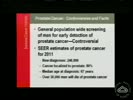
Prostate cancer is the second leading cause of cancer-related deaths among men in the United States. It is estimated that in 2010, approximately 32,000 American men died of prostate cancer and 218,000 were newly diagnosed with the disease. Most prostate cancers are detected by a blood test that measures prostate-specific antigen (PSA), a tumor marker. More than half of cancers detected with PSA screening are localized (confined to the prostate) and are not aggressive at diagnosis, and are unlikely to become life-threatening.
However, 90 percent of patients receive immediate treatment for prostate cancer, such as surgery or radiation therapy. In many patients, these treatments have substantial short- and long-term side effects without any clinical benefit. Appropriate management of screen-detected, early-stage, low-risk prostate cancer is an important public health issue given the number of men affected and the risk for adverse outcomes, such as diminished sexual function and loss of urinary control. Currently clinicians rely on two observational strategies as alternatives to immediate treatment of early-stage prostate cancer: watchful waiting and active surveillance.
To better understand the benefits and risks of active surveillance and other observational management strategies for PSA screening-detected, low-grade, localized prostate cancer, the National Institutes of Health has engaged in a rigorous assessment of the available scientific evidence. This process, sponsored by the National Cancer Institute, the Centers for Disease Control and Prevention, and the Office of Medical Applications of Research will culminate in a Consensus Development Conference December 5–7, 2011.
Role of active surveillance in the management of men with localized prostate cancer [electronic resource] / NCI, CDC, and OMAR.
Author:
National Cancer Institute (U.S.) Centers for Disease Control (U.S.) National Institutes of Health (U.S.). Office of Medical Applications of Research.
Publisher:
[Bethesda, Md. : National Institutes of Health, 2011]
Abstract:
(CIT): Prostate cancer is the second leading cause of cancer-related deaths among men in the United States. It is estimated that in 2010, approximately 32,000 American men died of prostate cancer and 218,000 were newly diagnosed with the disease. Most prostate cancers are detected by a blood test that measures prostate-specific antigen (PSA), a tumor marker. More than half of cancers detected with PSA screening are localized (confined to the prostate) and are not aggressive at diagnosis, and are unlikely to become life-threatening. However, 90 percent of patients receive immediate treatment for prostate cancer, such as surgery or radiation therapy. In many patients, these treatments have substantial short- and long-term side effects without any clinical benefit. Appropriate management of screen-detected, early-stage, low-risk prostate cancer is an important public health issue given the number of men affected and the risk for adverse outcomes, such as diminished sexual function and loss of urinary control. Currently clinicians rely on two observational strategies as alternatives to immediate treatment of early-stage prostate cancer: watchful waiting and active surveillance. To better understand the benefits and risks of active surveillance and other observational management strategies for PSA screening-detected, low-grade, localized prostate cancer, the National Institutes of Health has engaged in a rigorous assessment of the available scientific evidence. This process, sponsored by the National Cancer Institute, the Centers for Disease Control and Prevention, and the Office of Medical Applications of Research will culminate in a Consensus Development Conference December 5-7, 2011.
Subjects:
Early Detection of Cancer Population Surveillance Prostatic Neoplasms--diagnosis Prostatic Neoplasms--epidemiology United States--epidemiology